Polls have invaded Britain from Australia that are asking the question of banning cigarettes to the sample about whether they would agree or disagree. Such polls were conducted in Oceania where the issue was raised by public health experts from the University of Queensland and the government of New Zealand who want to set an ascending age limit for the sale of tobacco, and were responded affirmatively against cigarettes by slight majorities in the fifties of per cent. In Britain 54% decided they don’t need cigarettes with a narrow minority of men of 49% in favour and slight majority of women.
First of all most people have been asked an irrelevant question to their actions which concerns someone else in the same way, that is those who smoke who would unanimously vote against such a ban. Such a ban is not logical and cannot be driven by the majority but be decided by each person separately.
Those who want to sell cigarettes, those who want to make them and those who want to consume them is what this question would be about if everyone minded their own business and did their job properly and then those who chose not to consume cigarettes would be the anti-smoking fanatics or those wanting to ban them in respect of others who are using them.
The majority’s opinion is not valid in this example, it is up to each person separately about what they will do. These decisions do not rely on the opinion of the majority. They are not collective but individually exercised decisions in a democracy where everyone can get their way. We have seen that the majority’s opinion is not valid when it is about each person when standing alone. That is why the majority cannot override the rights of the minority in the name of democratic rule but the accomplishment of mob rule.
Besides, illegal drugs are already prohibited and smoking tobacco cannot be prohibited as well as illicit drugs on the same terms with each other because this does not equal the other. You don’t allow drugs to be sold instead of tobacco and that is quite clear and straight forward. If you want to prohibit tobacco then there will be drugs and their users who will take the position of doing nothing wrong with consuming them and the state does not want that to happen. If forefront drugs are legalised then how can you expect them to be sold commercially by stating that tobacco isn’t allowed? It doesn’t make any sense, and neither does antismoking fanaticism make any sense.
The smoking bans, plain packaging laws and excessive tax hikes are unconstitutional examples of exerting individually sufficient decisions and the abuse of political power. And so because those decisions rely on each person separately and have been made collectively and erroneously involved those accepting them for themselves to make them in respect of all the rest. That is what importantly satisfies the condition of conducting a poll with the members of parliament as the sample.
It appears that most people in Australia or New Zealand want to ban smoking cigarettes but that would make people consuming drugs appear to be doing the same as smoking them. People who already smoke have up-voted their actions of buying cigarettes and would not like to see them banned, maybe out of definition, but definitely unanimously, so the question is favourably targeted to those who do not smoke to contribute their opinion on an irrelevant question that affects others and so is the concern of others and not them.
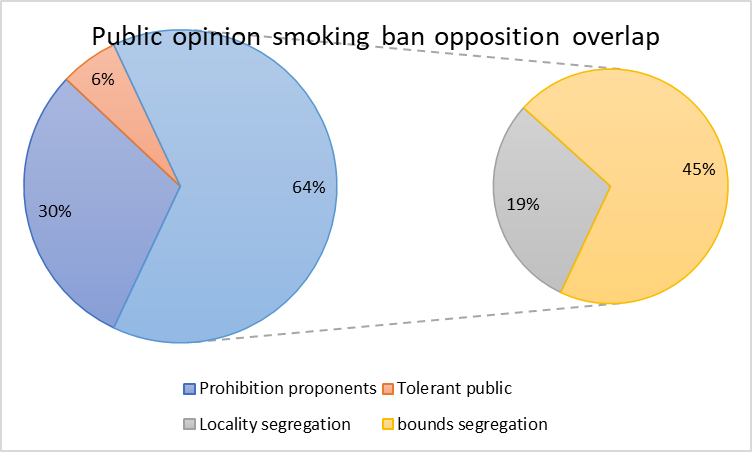
Maybe 54% of Britons would agree with banning cigarettes and smoking them without being narcotic drugs, but agreeing or disagreeing with banning smoking indoors is a different question that is unrelated as set and related in consequence. Most people in the year 2007 when that took place disagreed with it as a proportion of 68% – 70% and maybe this has not changed or not changed much regardless of whether 54% would agree to see cigarettes banned, because both questions are asked independently of each other and can be answered differently. How 54% can agree to banning smoking legal tobacco and not narcotics but 70% agree with it taking place indoors as well is a question to be made about the nature of the poll because this still happens and the majority disagree with what is ongoing which has not prevented it from taking place.
 Bring Back Smoking Freedom