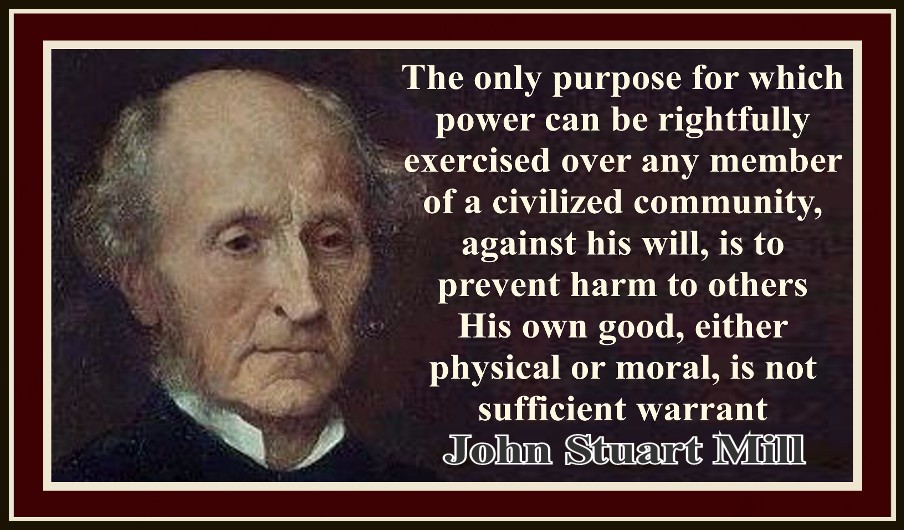
Self regarding action refers to actions which directly affect only the individual performing the action… The individual is not accountable to society for his actions in so far as these concern the interests of no person but himself.
John Stuart Mill (1806 – 1873)
The sole end for which mankind are warranted individually or collectively in interfering with the liberty of action of any of their number is self-protection that the only purpose for which power can be rightfully exercised over any member of a civilized community against his will is to prevent harm to others.
John Stuart Mill (1806 – 1873)
To what extent does society have the right to control and impose limits on thoughts beliefs and actions of individuals?
The 19-th century philosopher John Stuart Mill thought this question to be of monumental importance. In his famous work “On Liberty” written over a century ago Mill predicted that such a question is likely to make itself recognized as the vital question of the future. Given the ubiquity of state tyranny in the 20-th century and the threats to Liberty that loom over us today Mill’s prediction seems to have come true.
In this video we will provide a summary of Mill’s highly influential work “On Liberty” in which he sets out to investigate in his words the nature and limits of the power which can be legitimately exercised by society over the individual.
Before we proceed we must first understand who or what exercises power over individuals in a society.
As is well known to most people governments be the authoritarian monarchical or democratic are always a threat to individual liberty. Thomas Jefferson in fact stated that “the natural progress of things is for Liberty to yield and government to gain ground”. Mill recognised the threat governments posed but he also postulated that there is a subtle and more anonymous social force which also destroys the freedoms of individuals.
Every society comes to adopt customs beliefs opinions and attitudes which are accepted by the majority as the right way of thinking and living individuals who show signs of deviating from this right way of living are shunned and ostracised by the majority and are thereby pressured to conform and adopt the socially accepted way of living and thinking.
Mill called this social force the tyranny of the majority and claimed it to be the primary manufacturer of conformity.
As he wrote, “when society is itself the tyrant, society collectively over the separate individuals who compose it, its means of terrorizing are not restricted to the acts which it may do by the hands of its political functionaries. Society can and does execute its own mandate and if it issues wrong mandates instead of right or any mandates at all in things with which it ought not to meddle it practises a social tyranny more formidable than many kinds of political oppression since though not usually held by such extreme penalties it leaves fewer means of escape penetrating much more deeply into the details of life and enslaving the soul itself.”
We’ll believe that because Liberty was one of the leading essentials of well-being that individuals must take positive steps to ensure that their liberties are not destroyed it should be noted however that some have suggested that Mill overstated the threat of the tyranny of the majority and understated the threat posed by governments.
An important distinction which Mill does not address is the different way that freedoms are destroyed by governments versus the tyranny of the majority. Governments who maintain a monopoly of legitimised force within a certain area coerce individuals with force and any individual who tries to evade the dictates of a government faces imprisonment or even death. However the tyranny of the majority on the other hand must use criticism and ostracism to impose their way of living on individuals; as such it is much easier for someone to ignore the tyranny of the majority than it is for them to ignore the tyranny of a government, however had Mill lived to see the atrocities committed by the totalitarian governments of the 20-th century his opinion on the relative threats of governments versus the tyranny of the majority may have been different.
That point aside, Mill did not think individuals should be completely free to do exactly what they want without any restraint with respect to the actions of individuals. He thought society had a right to exercise power over individuals within a limited domain.
To delineate where he thought it was appropriate for society to exercise power and where it was not Mill differentiated between two types of action – other regarding action and self regarding action; self regarding action refers to actions which directly affect only the individual performing the action – self regarding actions which are disallowed by a government are somewhat analogous to what are called victimless crimes such as the use of illicit drugs. With respect to actions of this nature Mill believed society has no right to intervene.
The individual is not accountable to society for his actions in so far as these concern the interests of no person but himself.
Other regarding actions refer to actions which directly affect other individuals.
Mill maintained that if an individual performs an action which harms another individual or which encroaches on their basic rights then such an individual should be punished and if needed incarcerated. This Mill stated, is the only legitimate power which society has over the individual. As he wrote, “the sole end for which mankind are warranted individually or collectively in interfering with the liberty of action of any of their number is self-protection that the only purpose for which power can be rightfully exercised over any member of a civilized community against his will is to prevent harm to others.”.
While he proposed that society has a right to exercise power over an individual if his actions harm others Mill held that the freedom to hold and express beliefs and ideas of one’s choosing should be completely unconstrained. If all mankind, one were of one opinion mankind would be no more justified in silencing that one person than he if he had the power would be justified in silencing mankind.
Mill proposed that the freedom to entertain a wide variety of ideas and to express those ideas without fear of punishment was not only crucial to the healthy development of individuals but also of society at large.
He put forth two main reasons why society benefits when ideas are not suppressed but allowed free expression. Firstly, Mill proposed that in suppressing an idea a society runs the risk that it is suppressing the truth. Human beings are fallible creatures and every society throughout history has falsely mistaken their most cherished ideas for absolute truths; a society should therefore allow free expression of even the most unorthodox ideas, for these ideas may turn out to contain more truth than the ideas the majority accepts. As true the opinion which it is attempted to suppress by Authority may possibly be true, those who desire to suppress it of course deny its truth but they are not infallible yet it is as evident in itself as any amount of argument can make it that ages are no more infallible than individuals.
Every age, having held many opinions which subsequent ages have deemed not only false but absurd and it is as certain that many opinions now general will be rejected by future ages as it is that many once general are rejected by the present.
Moreover, Mill maintains that even if an individual or society at large covets an idea they are certain is true it is still not beneficial to suppress all opposing ideas for even if one has arrived at the truth it is necessary that contradictory ideas exist. A true idea, Mill insightfully proposed, retains its strength and vigour only so long as it is constantly under attack by conflicting ideas. Once the true idea is accepted as absolute and labelled as untouchable it loses all that which makes truths valuable. However unwillingly a person who has a strong opinion may admit the possibility that his opinion may be false he ought to be moved by the consideration that however true it may be if it is not fully frequently and fearlessly discussed it will be held as a dead dogma not a living truth.
Liberty of thought and Liberty of action combined to give rise to the freedom to cultivate one’s individuality. The freedom to be a unique and eccentric, says Mill, held essential for social progress when individuals break free from the tyranny exercised by both governments and the majority and live unconventional lives; Mill proposed that they undergo what he called experiments of living. These experiments are what drives both individual and social development. As Mill wrote as it is useful that while mankind are imperfect there should be different opinions so it is that there should be different experiments of living and that the worth of different modes of life should be proved practically when anyone thinks fit to try them.
It is desirable in short that in things which do not primarily concern others individuality should assert itself.
Where not the person’s own character but the traditions or customs of other people are the rule of conduct there is wanting one of the principle ingredients of human happiness and quite the chief ingredient of individual and social progress.
We’ll observe that in his day, eccentric individuals were wanting, leading him to fear that the tyranny of the majority would soon gain complete control over the development of individuals, as when conformity becomes all pervasive social stagnation sets in and human beings lose all that which makes them superior creatures in the animal kingdom.
He who lets the world or his own portion of it choose his plan of life for him has no need of any other faculty than the ape like one of imitation. Because of this danger Mill called for individuals to practise nonconformity solely for the sake of breaking the chains of custom and displaying two people that different ways of living and thinking are possible, for it is only in a society where nonconformity and eccentricity are pervasive that social progress is achievable.
In this age the mere example of nonconformity, the mere refusal to bend the knee to custom is itself a service precisely because the tyranny of opinion is such as to make eccentricity or approach. It is desirable in order to break through that tyranny that people should be eccentric. Eccentricity has always abounded when and where strength of character has abounded and the amount of eccentricities in a society has generally been proportional to the amount of genius mental vigour and moral courage it contained that so few now dare to be eccentric.
Marx, the chief danger of the time, all too often people misunderstand, the importance of individual liberty and think that individual freedoms should be sacrificed for the greater good.
Other individuals erroneously think that Liberty only serves the selfish ends of the individual at the expense of society at large, but as Mill so eloquently explained in his classic work, the greater good is only served by allowing individuals to do and think as they please so long as their actions do not harm others.
One can only hope that in the modern day when so many threats to Liberty loom over us that more and more individuals will come to understand this all-important truth.
To finish this lecture, we will provide a passage from HP Phillips in which he echoes John Stuart Mill’s message regarding the importance of liberty throughout history. “Orator and poets have extolled Liberty but no one has told us why Liberty is so important. Our attitude toward such matters should depend on whether we consider civilization as fixed or as advancing. In an advancing society any restriction on Liberty reduces the number of things tried and so reduces the rate of progress. In such a society freedom of action is granted to the individual not because it gives him greater satisfaction but because, if allowed to go his own way he will on the average serve the rest of us better than under any orders we know how to give.”
Source : Academy of Ideas
 Bring Back Smoking Freedom