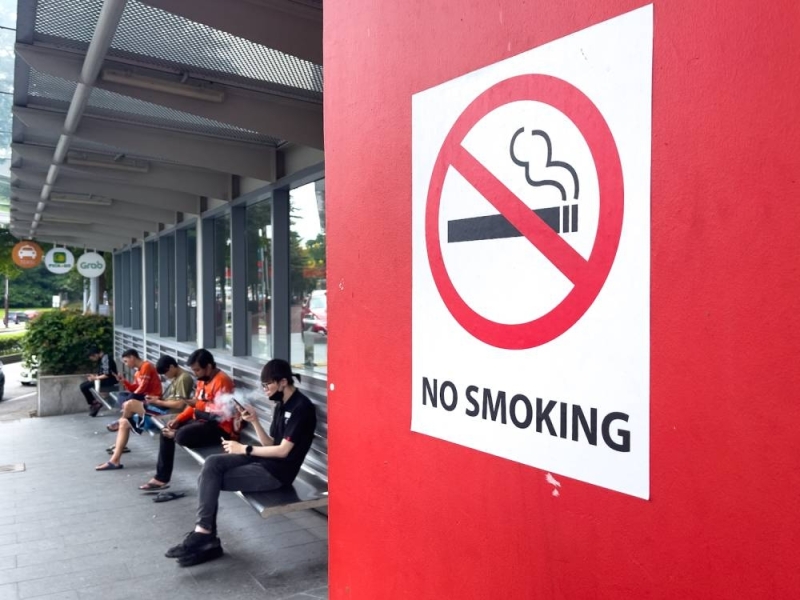
While the Indian prime minister of the United Kingdom Rishi Sunak has announced a generational ban on smoking as his own inspiration that is supported by the main opposition party rather than the majority of his own MP’s, the same legal requirement has been declared unconstitutional by the Attorney General in Malaysia, an underdeveloped third-world nation that appears to be ahead of the United Kingdom and other western nations and especially New Zealand in respecting human rights such as the right to full emancipation under legal responsibility of a mature age for its citizens and recognising the importance of establishing rather than decomposing civil liberties.
The clause of a generational ban on smoking for those born after a certain date on the 1st of January 2007 has been dropped from the drafted tobacco control bill in Malaysia after the Attorney General compared the draft law to Article 8 of the Federal Constitution and conferred his judgement that while all citizens are equal before the law the clause for a generational ban on smoking created two tiers of citizens and placed them in separate categories according to the criterion of their age.
“The Attorney-General’s Chambers has strong views, especially on Article 8 of the Federal Constitution. To them, there will be two sets of laws for two different groups of citizens based on age.” reads the ruling by the Attorney General Ahmad Terrirudin Mohd Salleh who believes that the clause for banning future generations from purchasing tobacco violates Article 8 of the Federal Constitution that guarantees equality before the law, who mentioned that passing of this clause would require amending the constitution to accept it which requires a parliamentary majority of at least two thirds which is unlikely to be obtained by the current government even though it has the required seats in parliament.
As a result of the Attorney General’s ruling the clause of the Malaysian tobacco control bill that bans anyone born after 2007 to purchase tobacco or vaping products has been decoupled from the draft legislation and can be considered at a later stage next year or indefinitely.
Tourism, arts and culture secretary Tiong King Sing was one of the ministers who opposed the clause in the bill and said that “Especially in the 21st century and in a civilised society, this high-pressure implementation and coercive action is akin to parents who cane or punish their child without prior checks or examination. His [The health secretary’s] response reflects his inability to accept the decision that this bill is unconstitutional and unenforceable.” Meanwhile, Youth and Sport minister Hannah Yong said that “a law that’s unenforceable and unconstitutional will cost the government millions” while she declared her joint opposition to the same clause in the tobacco control bill.
Last April of this year former Chief Justice Zaki Azmi expressed his views against the generational ban on smoking when he said that “The generational end game should not be at the forefront of the Tobacco Bill at this point of time. It should be decoupled and subjected to a comprehensive review given its socio-economic impact. It is undeniable that the road to a tobacco-free society is paved with good intentions, but have we truly exhausted all policy options before risking a radical, abrupt, and untested approach? I urge the government to tread with conscience as this could lead to another Pandora’s box of abuse and erosion of civil liberties. Despite the trappings of an ambitious piece of legislation, one simply cannot turn a blind eye to the inextricable legal perils it presents. Rather than an arbitrary cut-off point of access, the government introduces less harmful cigarette alternatives in the market as a go-to option. Despite a much lower smoking prevalence compared to Malaysia, New Zealand’s comprehensive vape regulation demonstrates that endgame tobacco strategy must be supplemented with a harm reduction approach during the transitional phase. The refusal to acknowledge the chokehold nicotine addiction has on smokers is a policy failure and it will simply turn them away from seeking help; or worse, to unregulated illicit cigarettes or vapes in the black market.”
In vetoing unanimous objection from the Poisons Board, the health minister deregulated liquid nicotine as a scheduled poison from the Poisons Act 1952 last March 31. This means that if a version of the law is not passed by the end of the month when parliament closes everyone including minors and underaged children will be allowed to buy vaping products for at least one year. Next December 6, the High Court is set to hear a judicial review application by three civil society groups, including the Malaysian Council for Tobacco Control, to place liquid nicotine back into the Poisons List.
 Bring Back Smoking Freedom