British prime minister Rishi Sunak is professionally and fully engaged with the war that broke out in Israel between the Israelis and Palestinian Hamas militants, more than it would take to implement like he said he would before a generational quagmire for smoking to annually and gradually increase the required age to buy tobacco by one year every year and phase Britons out of smoking out of the top of their death. There appears to be less time with much less energy for this plan to proceed at the present time.
Rishi Sunak’s antismoking plan whose consideration and implementation was proposed to him by antismoking proponents sank way down in line of priority with the break of war and its development into a more serious political situation. So it appears much less likely to be considered any further by this government for the near and prospective future after the prime minister has politics imposed onto him as his duty and job owing to the break of war. This is evident by making the comparison to before and after the war broke out, a specific period of time over which the same announcement could not have been made.
Antismoking policies and the introduction of further restrictions on smoking not being part of the political agenda at times during which urgent political crises need the government’s detailed attention is clear to conceive by taking the example of the war that broke last year in Ukraine and the subsequent rise of inflation to over 10% which followed it as a result, when combatting smoking even further was paused out of the question for a short while giving smokers the necessary break that they deserved.
The so-planned generational quagmire for smoking would still require a parliamentary majority to turn out according to Rishi Sunak’s provided description, and it would obtain that from the Labour Party more than it would from his own party. The Labour Party has endorsed their full support for this unlike many Conservatives and it going ahead in the running five-year term would depend on how many Conservatives are for or against.
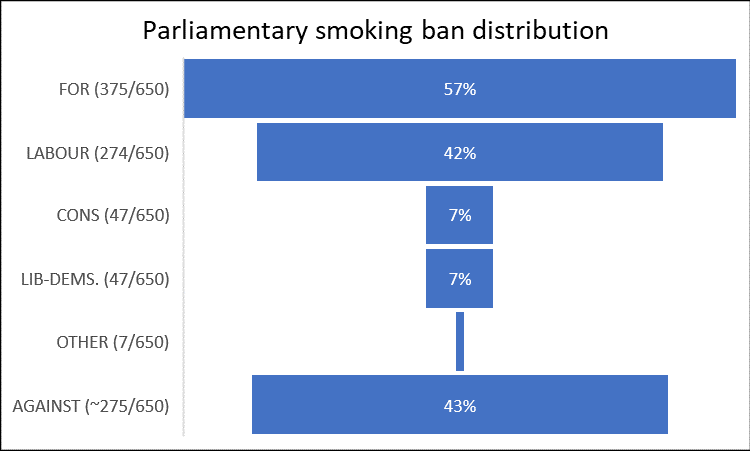
Given the 650 seats in the House of Commons, the current smoking ban was voted down by all but 47 Conservative seats in the main opposition in 2007, another 47 seats by the Liberal-Democrats, and 7 seats from the other parties, but the Labour seats that supported it were 274, receiving 275 negative votes in total. This also means that if the other-party, Conservative and Lib-Dem votes had not been casted in favour of the smoking ban, it would not have passed with a margin of a single vote by the Labour votes being counted alone.
 Bring Back Smoking Freedom