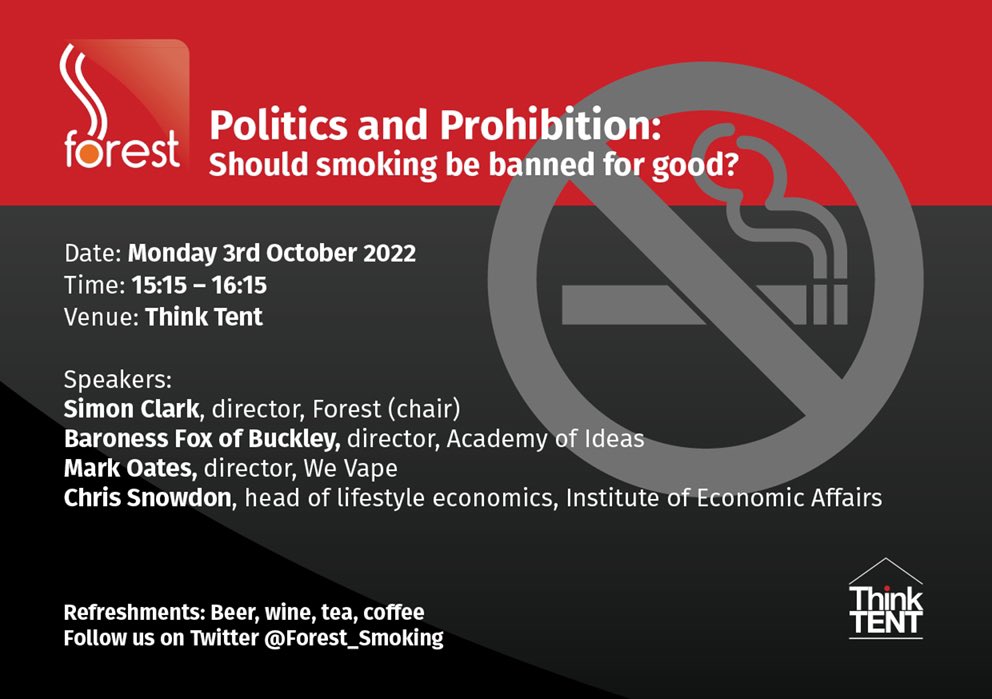
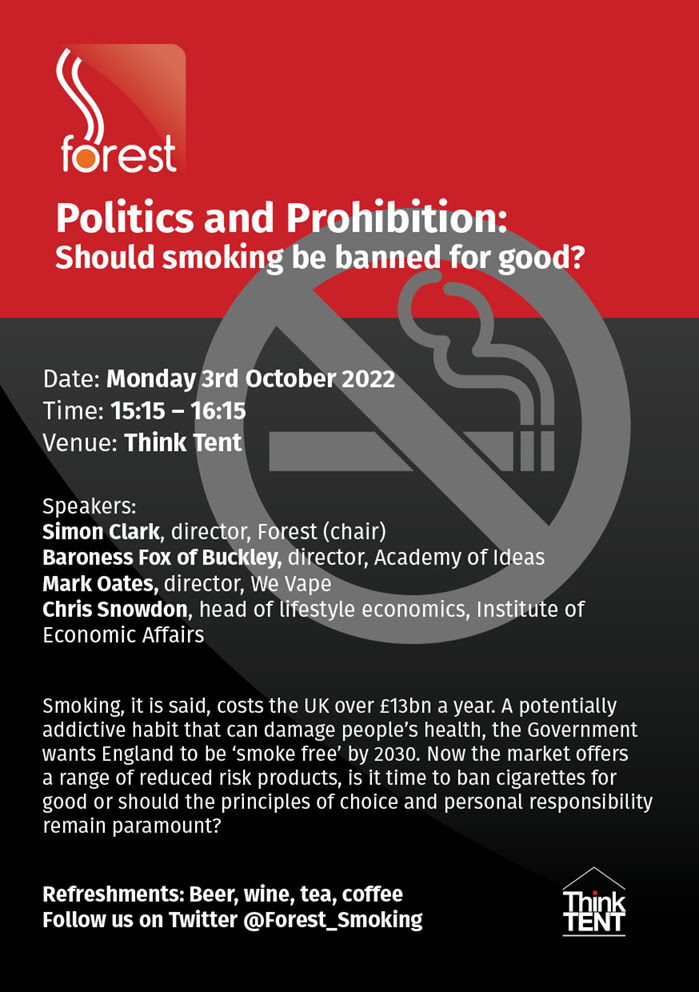
British smokers’ association Forest organized a round table on Monday 3 October at the Conservative Party Conference held during the recent days of October in Birmingham. Several issues were discussed at the roundtable, but the general theme was whether smoking should be banned permanently for the consumer public. More specifically, the topic as stated in its title is “Politics and prohibition: should smoking be permanently banned?”
The description given on the subject was that ‘Smoking, it is said, costs the UK over £13 billion a year. A potentially addictive habit that can damage people’s health, the government wants England to be ‘smoke-free’ by 2030. Now that the market offers a range of reduced-risk products, it’s time to ban cigarettes for good, or should the principles of choice and individual responsibility remain primary?’
During the conference call by the committee of four Liberal leaders, including union president Simon Clarke, which took questions from reporters at the end, the union’s continued participation in the biennial Conservative party conference for the previous 15 years was mentioned.
The panel was addressed by Christopher Snowdon, Head of Lifestyle Economics at the IEA (Institute of Economic Affairs) of London, Baroness Claire Fox who runs the London Academy of Ideas and has a seat in the House of Lords and Mark Oates, director of the vapor union We-Vape.
One of the points made about the government’s vision to reduce smoking rates to 5% (1/20) of the total population by 2030 was that 50% of people who smoke do not want to or cannot or do not intend to in short to quit although this figure has often been put forward as 10% from 90% of smokers who want to quit and therefore 5% of the total population does not represent the actual proportion of Britons who want to smoke.
“People should be free to smoke if they choose to, but the government is doing a poor job of letting people know that vaping is much safer than smoking. To achieve what they say “smoke-free” you need as many options as possible. It’s not a pony with a single ponytail. I’m a big fan of vaping, but vaping doesn’t work for everyone.” said Mark Oates.
It was also reported that smoking has been completely banned from everywhere so far in three countries, in Bhutan where it was allowed only after the pandemic due to the exacerbation of the smuggling of tobacco products that were not completely allowed in the country until then, in the Islamic State of Syria and Levance and in South Africa during the pandemic crisis, a restriction ruled unconstitutional by the country’s highest appeals court as a temporary smoke ban, although the fact was not mentioned by panelists.
Although in the Republic of Ireland the price of cigarettes is increased by 50 Euro cents each year until they are priced at over €15.50 at present, some of the harshest measures proposed were to increase their price by 30% overnight, banning actors from showing smoking scenes in motion pictures with movies showing smoking because of their needs to be rated 18, banning smoking in state-rented rental housing, which is already happening in the United States and Britain and other countries, on beaches and outdoor gathering places, and the introduction of individual health warnings on each stick.
It was mentioned by the speakers in relation to alternative electronic products and the sidelining of smoking that the state indulges in that things become obsolete because better things come along and replace them and that smoking is no longer convenient carried on as a pastime these days and that there needs to be a philosophical and pragmatic treatment of the whole subject. Speakers referred to the outright ban on smoking in hospitals by law, saying that there is the possibility of someone’s parent dying in hospital and being harassed by the police as they smoke borderline upon entry, or dying themselves and not being given the opportunity to smoke.
“The whole issue of health disparities has for years been used as a cover to force an upper-middle-class lifestyle on ordinary working-class and low-income people. I don’t have the answer, and neither does anyone else, how you can improve everyone’s circumstances, but you don’t actually help people in bad circumstances by taking away the things that make their lives a little better every day” said Christopher Snowdown.
 Bring Back Smoking Freedom