The first day of the 5th Scientific Summit on tobacco harm reduction at the Stavros Niarchos Foundation and its Cultural Centre in Athens, Greece, was completed on Wednesday 09/21. The conference featured scientists from many disciplines and scientists from British American Tobacco, detailing the Vuse (e-cigarette) and Glo (heater tobacco) products, from Juul Laboratories Inc. and from Philip Morris International. A Philip Morris speaker brought up examples of flawed research and tracking the flawed methodology with approximation errors that the rest of the audience agreed with.
Researches concerned smoking among people with mental health problems from the Psychiatric Hospital of Attica and among young people, mainly students from I.E.K. of Greece. The majority and overwhelming majority of up to 85% of the mentally ill were found to smoke and only 17% (17% x 85%) of them had stopped smoking, 97% (97% x 17% x 85%) of them had stopped smoking without additional help from guidance or medical supervision.
As for the students from the I.E.K., the majority of them as much as 2/3, compared to one third who diagnosed the opposite, did not know that electronic cigarettes and alternative products are a method of smoking cessation, they also did not know that the alternative products were less harmful than combustible smoking and had no motivation other than the initiative to stop smoking, although 90% versus 10% who declared ignorance knew about their existence. After the presentation of the results it was said by commenting that the results are particularly worrying for opinions coming from students and well-educated people.
Another study looked at CO levels of smokers and patients during the pandemic wearing or not wearing a mask where much higher CO levels were found in those who smoked and wore a mask.
It was discussed that more evidence and data are needed to inspire appropriate government policies to make more informed decisions and that 8 million deaths per year worldwide are caused by smoking despite widespread awareness of its health consequences. It was also noted that progress is slow for today’s needs and that tobacco control translates into harm reduction while empowering smokers to take control and address the problem.
During the first day of the conference, ten-minute abstracts were presented from the first of a total of 30 papers that follow tomorrow on Thursday, having a variety of medical and statistical topics. The keynote speech of the day and one of the three to follow on Thursday was given today by Marewa Glover via web conference from New Zealand.
Marewa Glover directs the COREISS Centre of Research Excellence for Indigenous Sovereignty and Smoking which has received $1.5 million in funding indirectly from Philip Morris through the multinational’s $1 billion grant over 12 years for the Foundation for a Smoke-free World having started at 2017.
Ms Glover began by giving a recent history, saying that smoking prevention in New Zealand dates back to as early as 1945. Tobacco taxes were introduced in 1979 and pharmaceutic smoking cessation methods were first used in 2006, two years after the indoor smoking ban in a world first at the same time as the Republic of Ireland in 2004.
Of the country of 5 million people only 9% are regular smokers while the same percentage was 10.5% in 2021 and 27% in 1992. The New Zealand government aiming to make the country smoke free for 2025 conflictingly attempts to pass a progressive age limit bill that would make the same goal a long-term reality.
The country’s Labor government’s bill was summed up by Marewa Glover at the science conference citing a prohibitive ethos of legislation and punitive treatment. Retail tobacco shops are set to fall from 500 to 1,000 out of 8,000 and the nicotine level of the cigarettes they sell are set to drop by an equally drastic 95%, measures which the New Zealand native described as dead ends compared to the progressively increasing age limit for buying tobacco.
Marewa Glover has strongly criticised the strict anti-smoking and vaping legislation affecting the citizens of her country, stating that the legislation cites the expediency of the social deregulation of vaping as an abnormal act, in particular, its cessation after the one of smoking that would have preceded it for which it had been used as a means. She also characterized that the situation in his country is moving from control to the prohibition of tobacco and prohibitive morality and that the strict prohibitions that plague it have detrimental effects on the right of individual autonomy and academic freedom where its destruction prevents reading and the dissemination of the truth and all existing views and that related phenomena are not consistent with tobacco harm reduction. According to the country’s vaping regulation, Marewa Glover said it prohibited consumer groups such as associations from discussing harm reduction from tobacco by promoting alternative products as solutions and giving relevant advice on its replacement. She added that the times have changed along with the possible products having the ability to completely replace and eliminate smoking which has been on a downward trend since the introduction of electronic cigarettes.
A Norwegian sociologist continued the conference by questioning whether the bans are moral or whether they are driven by emotion rather than rational treatment. It was also reported that 57% of tobacco products sold in Malaysia are smuggled and that the country is a tourist and secular hub.
Then the former minister of health in 2021 in Greece Vassilis Kontzamanis took the floor. Mr. Kontzamanis asked rhetorically if there is the will to impose strict measures and he answered that there is. He added that while no one expected the prohibitive measures to have the expected result, the country’s population finally complied with what the state regulated. He also added that obviously everything cannot be banned from one day on to the next, but the required surveillance has ensured that all activities are carried out as per the law imposed to serve the common good.
The question was then raised as to why there are people who are so addicted to smoking that they are unable to quit so that it is better understood why people use cigarettes and like smoking. In the continuation of the conference, a dentist specializing in the study of periodontitis (an advanced condition of gingivitis in which the gums recede, exposing the teeth) revealed that the use of electronic vaporizers damages the gums by causing periodontitis more than smoking.
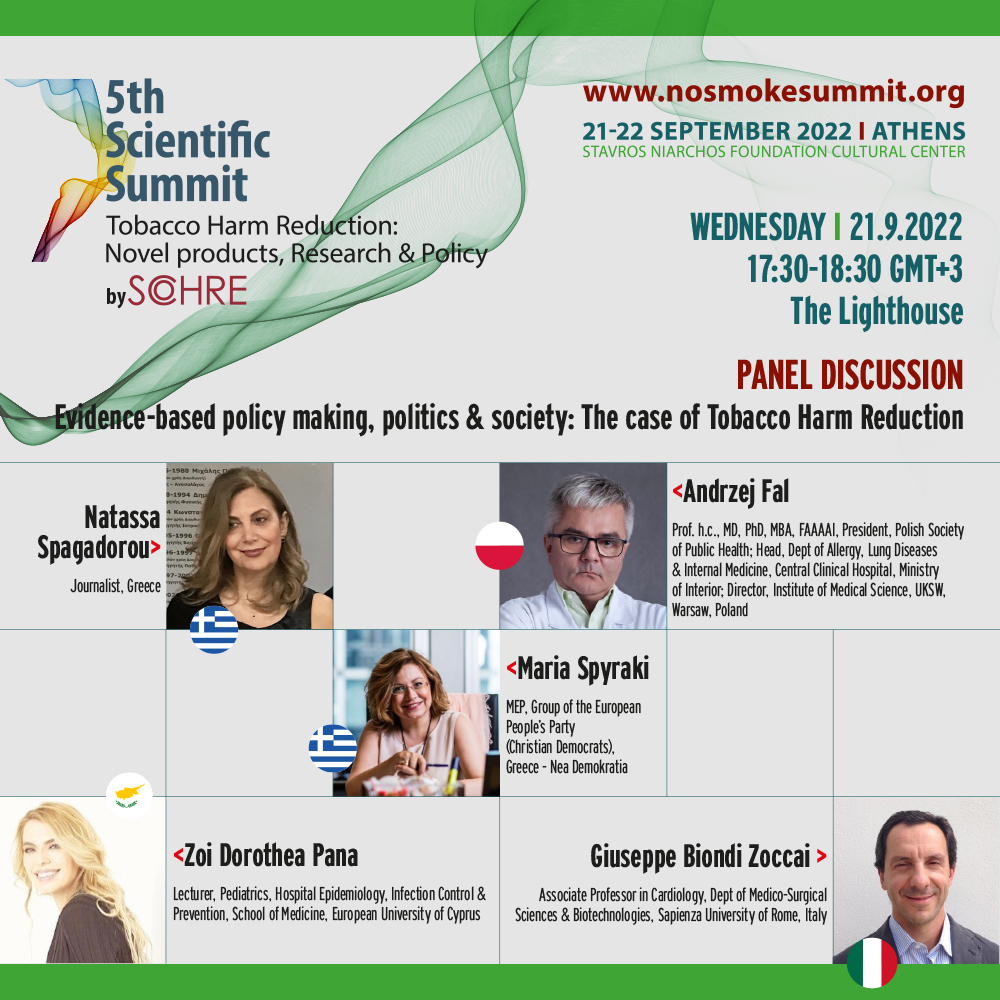
At the end of the first day of the conference, the question of the policy-making method was discussed. The need for politics with a human face without a punitive character in the context of the coexistence of people was emphasized. The MEP of the Christian Democratic faction of the European Parliament, Maria Spyrakis, who participates in the EU Beat Cancer Initiative stated that smoking is a thing of the past as are the more prominent measures to suppress it and referred to the cost of public health money it causes combined with the loss of human capital from the associated loss of conditions. It was also mentioned by other members of this panel that in an ideal world there is neither smoking nor drinking alcohol nor sugar or salt but our world is the real world and not the ideal. That governments are temporary for four years and then elections are called and therefore the policies they budget for must depend on parliaments. That the moving elephant in the room is a new generation addicted to modified risk products that might be discontinued for the same reason but conversely since the consequences of their use are almost non-existent why should that sound alarming?
 Bring Back Smoking Freedom
1 Comment